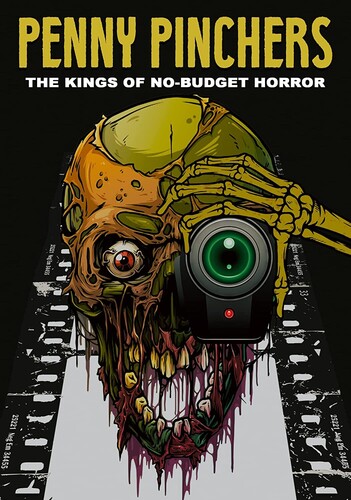
This review is both for “Penny Pinchers” and for “Penny Pinchers 2.”
The first Penny Pinchers, which has the tagline “The Kings of Low-Budget Horror” started with Lloyd Kaufman from Troma, which made me wonder if I had accidentally inserted a Troma movie into my DVD player, but it was an easy mistake to make because of Lloyd’s characteristic delivery.
Several indie directors offer their opinions and advice. Among these are Todd Sheets, Donald Farmer, Tim Ritter, and Phil Herman, none of which I have ever heard before. They talk about their early beginnings, and some footage is provided, but there is no “where are they now” bits, unless I missed something.
It is interesting to see what was once an alternative to mainstream VHS movies (when VHS itself was low quality), but some of the directors aren’t realistic about why things didn’t take off for them. While some of the footage looks like garbage, the important thing about that era is how forgiving some horror fans are. The same low quality would be instantly rejected if the movies were made for other categories, like action, mystery, thriller, or romance.
Some of the budgets seem extremely high, like one guy who said he spent $5,000. By comparison, the director of “Frankenhooker” (not in this documentary) told me he spent $8,000, but he would have spent less if he shot on video. Taking that into account, it’s only $3,000 more to make a movie like that, perhaps even less. This is not an accusation. It’s just something to think about while hearing the directors talk about how much money they spent.
It is by no means a small feat to make a full-length movie, even if it’s shot on the cheapest camera and with no budget.
Sadly, I have never heard of any of the directors, except for Lloyd Kaufman, so I can only guess about their work or the number of fans they have. There was some griping about not making money, so maybe there weren’t many sales, or maybe the directors were ripped off.
The interviews seem to be a tad on the surface level. It seems that the directors self-taped their interviews. The quality varies, with Lloyd Kaufman appearing pristine while others suffer various defects, like bad color, soft focus, or other subpar video quality, especially compared to Troma, but the documentary is about low budget so it might be silly to have superb quality of the director’s interviews while the examples of their work is bad.
I found the documentary to be enjoyable, but there was nothing really new. It’s not something that will teach, and any cautionary tale is lost because there is no update to where the directors stand currently. Actually, this was released in 2017, but there was no indication of whether people had quit or had gained status. Again, I never heard of any of the directors.
This brings us to the follow-up of Penny Pinchers 2, which has the tagline “Scenes from the Underground.” It’s the same format, with a new batch of low-ranking directors like Marcus Koch, Joel Wynkoop, Tony Newton, and others, none of which I have ever heard of.
This one made me laugh a few times because some of the directors didn’t hear themselves or detect their irony, like the guy who said that he wrote a sequel to “Last House on the Left” but no one took the script, but when a company offered a deal if “The First House on the Right” would be written, the director scoffed, saying that it was too gimmicky. Apparently, it’s not a gimmick to write a sequel to a popular movie that you had no part in making.
Another laughable moment was the director who said that it’s hard to sell a script, but he blamed everything except that maybe his scripts were bad or that he didn’t pursue it. If I write a book and send it out to a few publishers and never hear back, I can either quit or persevere, but it would be embarrassing to quit and to say that publishers just aren’t into newcomers. Also, if I omit that I didn’t have an agent and that publishers prefer to deal with agents, with some exceptions, then this further makes me look like a jackass.
There was some mention of bad distributors who rip off the directors. One guy said that distributors know that low-budget filmmakers don’t have the money to sue. That seems a bit presumptuous. It would be better to say that most people don’t have the perseverance to sue. It takes work to sue someone.
One of the distributors that were mentioned as good actually angered me. I purchased a movie from them and received a DVD-R. How is that even possible?
One bit of advice that was given was infuriating to hear. The director advised that you can burn your movie on a DVD-R. This is the most frustrating thing about going to a horror convention. There are unscrupulous indie directors who burn their movies onto discs and then they shrinkwrap them to look like real movies. Some argue that there is no difference between a burned disc and a factory-pressed one, but that is willful ignorance. Why shrinkwrap it? This makes consumers doubt the authenticity of the next indie director. It makes horror convention vendors look like scam artists. On the other hand, if a low-selling director admits, “Hey, this is a DVD-R” or makes it obvious on the packaging, then that is forgiven.
The documentary could have benefitted from opposing viewpoints, especially in regard to hoodwinking people into buying DVD-Rs. There is little sympathy to be gained if an indie director just cries about low sales when there is no inventory. He just burns discs as needed. But a director who pays for 500-1000 real DVDs from a replication facility must work hard to sell his stock. If the guy who spent $1200 or more for his discs laments his low sales, it is easier to pity him. Then again, if he just manufactures discs and does absolutely nothing for promotion, then he can cry himself to sleep. One thing that I wished to hear in this documentary was that success in moviemaking does not hinge on “If you build it, they will come.”
Both documentaries showcase low-budget directors, but it would have been interesting to see at least one example of a person who has succeeded. There was some pep-talk by directors to compel people to make movies if they want to, but people who make movies don’t need a pep talk, at least from what I have heard. There was some talk about the low chance of making money, so filming is a labor of love, but there are indie directors who make money. The documentary sent the wrong message. There is money in indie films. Perhaps in the third installment, some of the successful low-budget directors will be interviewed.
There wasn’t mention of crowdfunding, which is an explosive topic. Some indie directors raise more for a movie than most people earn in a year, while others barely raise the minimum. Also, many directors who raise a large sum end up pocketing most of the funds. When people contribute to a $20,000 movie, they expect a $20,000 budget, but the charlatans defend their betrayal by almost in unison stating “It’s acceptable for a director to take a share of the raised funds.” No. The funds are for the making of the movie. The director gets personal money from the SALES of the movie, not the making of the movie. This is not to be confused with traditional movies with proper budgets; the director gets a director’s fee, but that has nothing to do with crowdfunding.
The fakery of crowdfunding definitely would be a great topic because there are many differing opinions, some of them heated. There is also the scam of selling “producer” credits. If you go to the producers’ union website, you will learn what an associate producer does and what an executive producer does. These are roles you get paid to do, not roles that you pay the director to be listed as doing on imdb. It’s taking advantage of ignorant people. Actually, this is one of those hot-button topics that would make for a riveting debate.
That’s actually a point. It seems that each director was given the same questions, and then the replies were stitched together with some movie clips. I would suggest that if there is a third offering, there should be follow-up questions. It might even be possible to record everyone in a Zoom or Skype call so that people can not only get follow-up questions, but they can also fight, which is always fun to watch.
I would say that both of these documentaries are a fun watch, despite my criticism, because it’s funny to watch someone believe his own bullshit. There’s more than that, of course, but I personally enjoy that. Maybe it’s best for these to be free on youtube rather than on physical media because I don’t think there is much replay value, but it could be of value to preserve moments in indie history. It’s rather meta that the documentary is the thing that it covers – low budget.